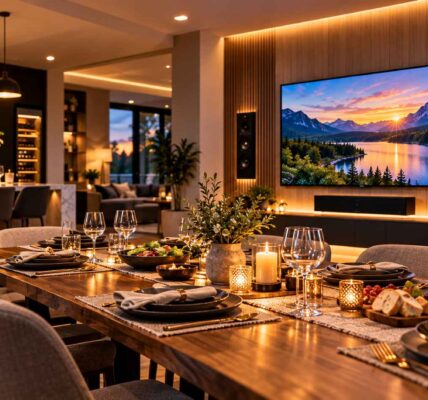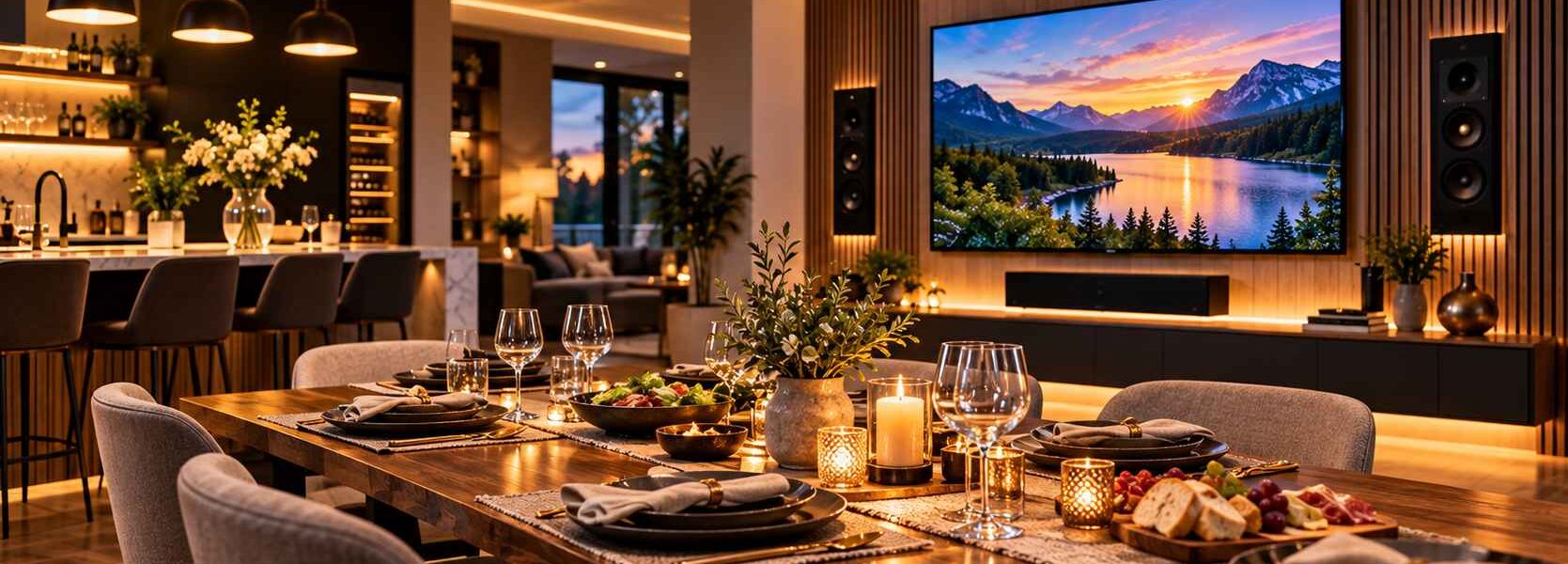
How Audio and Video Can Improve the Atmosphere of a Dining and Entertainment Space

A memorable dining experience is rarely about the food alone. The way a space sounds, looks, and feels can influence whether people settle in for a relaxed meal, stay for another conversation, or feel comfortable during a busy gathering.
Audio and video technology can contribute to that atmosphere when it is planned thoughtfully. Music can provide a subtle backdrop, a display can support a social occasion, and carefully coordinated lighting can help a room shift between different uses.
The important part is balance. Technology should support the experience without becoming the main feature of the room.
Start With How the Space Will Be Used
Before choosing speakers, televisions, displays, or other equipment, think about what actually happens in the space.
A kitchen and dining area might be used for family meals during the week, entertaining friends on weekends, and casual gatherings during holidays. A restaurant may need background music during dinner service while also requiring displays for menus, promotions, or entertainment.
Each use can create different requirements.
A multipurpose room may need flexible controls, while a dedicated dining space may benefit from a much simpler setup. Understanding the room’s purpose makes it easier to avoid adding technology that does not provide a practical benefit.
Use Music to Support the Atmosphere
Music can change the character of a dining space without demanding attention.
The challenge is finding the right balance between presence and volume. Music that is too loud can interfere with conversation, while music that is too quiet may disappear completely into the background.
Speaker placement matters as well.
Rather than concentrating sound in one location, a distributed arrangement can help create a more consistent listening experience across a larger area. This can be useful in open-concept homes where the kitchen, dining area, and living room share the same space.
The objective should be comfortable listening rather than making the room feel like a concert venue.
Think About Speaker Placement Early
Speakers do not always need to be the most visible objects in a room.
Depending on the design and purpose of the space, homeowners or hospitality operators may prefer equipment that blends into the surroundings.
Speaker placement should be considered alongside furniture, walls, cabinetry, and other design elements.
For example, a speaker positioned directly beside a frequently occupied seat may create a very different experience from a system designed to distribute sound more evenly throughout the room.
Planning before furniture and finishes are finalized can provide more flexibility.
Create Different Audio Zones
Not every part of a property needs to play the same music at the same volume.
A home may have different preferences in the kitchen, dining room, living room, patio, or basement. A restaurant may need different considerations for its dining room, waiting area, bar, or outdoor space.
Audio zones allow these areas to be treated separately.
A household might listen to music in the kitchen while keeping the dining area quieter. During a gathering, several spaces could potentially be grouped together when appropriate.
The advantage is flexibility without requiring every room to operate exactly the same way.
Add Video Without Letting It Dominate
Televisions and displays can be useful in dining and entertainment spaces, but their placement requires some thought.
A screen can provide entertainment during a casual meal, support a sports gathering, or display information in a commercial environment. At the same time, a large black rectangle can become visually dominant when the screen is not being used.
Placement should therefore consider both active and inactive viewing.
Think about sightlines from the main seating areas, viewing height, natural light, reflections, and how the display interacts with furniture and décor.
In a home, the best location may not be the largest available wall. In a restaurant or hospitality setting, visibility needs may be different depending on the purpose of the display.
Reduce Visible Cable Clutter
Cables can quickly undermine an otherwise carefully designed room.
Televisions, speakers, networking equipment, streaming devices, and other components may each require connections. When those connections are left unmanaged, they can create unnecessary visual clutter.
Cable planning should happen early.
During a renovation, homeowners may have opportunities to consider where equipment will be installed and how connections can be routed. In an existing room, practical cable management can still make equipment appear much more organized.
Accessibility is important too. Connections and equipment may eventually need maintenance or replacement, so hiding everything permanently is not always the best approach.
Coordinate Technology With Lighting
Lighting and audiovisual equipment can work together to create different moods within the same space.
A dining area might use brighter lighting during meal preparation and softer lighting when guests arrive. A home entertainment area may need a different setting when people are watching a film compared with when they are simply talking.
Automation can make these transitions easier when the systems are designed to work together.
For spaces where speakers, displays, networking, and controls need to function together without making the room feel overly technical, integrated audio and video systems can be considered as part of the broader planning process.
The goal is not to automate every possible function. It is to make the controls that matter easier and more consistent.
Consider Networking as Part of the Experience
Modern entertainment systems often depend on connectivity.
Streaming services, connected televisions, music systems, control applications, and other devices may all require access to the household or business network.
That makes networking relevant to dining and entertainment spaces even when the network equipment itself is not visible.
Homeowners should consider where connectivity is needed and whether the existing network can support the planned setup.
Restaurants and other hospitality environments may have additional considerations because staff systems, customer-facing displays, payment equipment, music, and other connected technologies can share the same property infrastructure.
The exact requirements will vary, but networking should not be left until the final stage of an audiovisual installation.
Plan for Renovations Before Work Begins
Renovations create an opportunity to coordinate technology with the physical space.
If a kitchen, dining room, basement, restaurant, or entertainment area is already being redesigned, it may be easier to think about speaker positions, display locations, power, cabling, and equipment storage before finishes are installed.
This does not mean every renovation needs an elaborate technology system.
It simply means that audiovisual decisions can be considered alongside the room’s layout instead of being added after everything else is complete.
Early planning can also help protect the visual character of the space.
Keep Controls Simple
A sophisticated system is not necessarily a convenient one.
If a homeowner needs several remotes and multiple applications just to play music or adjust the lighting, the technology can become frustrating.
The same principle applies to commercial environments. Staff should be able to understand basic controls without having to navigate an unnecessarily complicated interface.
Controls should focus on common activities.
Simple functions such as volume adjustment, source selection, lighting changes, and display control should be easy to find and understand.
The best control system is often the one people can use without having to think about how it works.
Design Around Conversation
Dining is fundamentally social.
Whether it is a family dinner, a dinner party, or a restaurant meal, conversation remains an important part of the experience.
Audiovisual technology should support that rather than compete with it.
Music levels should allow people to communicate comfortably. Displays should be positioned so they do not force everyone to turn away from the people around them. Speakers should contribute to the atmosphere without becoming distracting.
This is particularly important in spaces designed for entertaining.
Technology should create an environment people enjoy spending time in, not one that demands their attention.
Make Multipurpose Spaces More Flexible
Many modern homes use the same space for several activities.
A dining area might become a work area during the day and an entertainment space in the evening. A kitchen island may serve as a breakfast area, homework station, and gathering point.
Technology can support this flexibility when it is planned accordingly.
Adjustable lighting, distributed audio, and straightforward entertainment controls can help the same room serve different purposes without requiring major physical changes.
Commercial spaces can benefit from similar thinking. Restaurants, cafés, lounges, and other venues may use technology differently throughout the day depending on customer activity and operational needs.
Think About Long-Term Usability
Technology should remain useful after the initial excitement of installation has passed.
Before adding a new system, consider who will use it, how frequently it will be used, and whether it solves a genuine problem.
Future flexibility also matters.
A homeowner may rearrange furniture or renovate a room later. A restaurant may change its layout or introduce new equipment. Accessible cabling and sensible equipment locations can make future changes easier.
It is rarely possible to predict every future technology requirement, but planning for reasonable adaptability can help prevent unnecessary disruption.
Let the Room Come First
The strongest dining and entertainment spaces are not necessarily those with the most technology.
They are spaces where the technology makes sense within the environment.
Music can create atmosphere without overpowering conversation. Displays can provide entertainment without dominating the décor. Lighting can change the mood without requiring complicated controls. Networking can quietly support connected equipment in the background.
The same principle applies whether the setting is a family dining room, a renovated kitchen, a home entertainment area, or a commercial hospitality space.
Start with the people and the experience.
Then decide which technology genuinely improves that experience.
When audiovisual equipment is planned around the room instead of added as an afterthought, it can become a natural part of the environment. The result is a space that feels comfortable, flexible, and inviting while still providing the technology needed for everyday living and entertaining.